After my first, not-disastrous attempt, I tried making Noni’s pizza a second time, with greater success.


I stuck with the original recipe, but used The Joy of Cooking to fill in the details that are missing in this one:
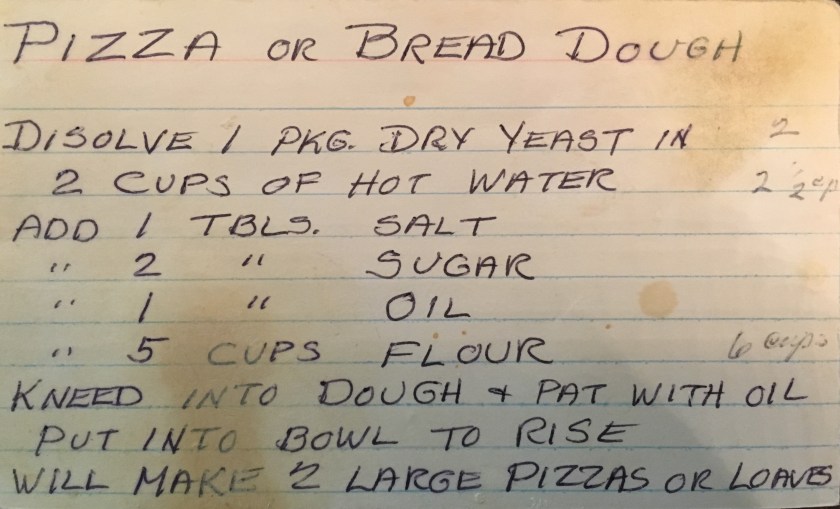
The ingredients are the same in both recipes, but the amounts differ. Noni’s has a higher yield, and calls for more water, more flour, and more sugar than The Joy of Cooking. Consulting a reference source helped me to figure out the times for mixing the ingredients, kneading, letting the dough rise, etc.
I also appreciated that Joy suggested first mixing the yeast and hot water in the mixer bowl, thus eliminating one dirty measuring cup (because why would I wash something that only held water). Finding little efficiencies like this is super satisfying to me.


The dough came together in much the same way as it had the first time. When baking with my dad as a kid, I’d been taught to mix the sugar with the yeast and hot water. I think it was something about the yeast consuming the sugar, but since neither recipe specified this, I didn’t do it.
I departed from Noni’s recipe in letting the standing mixer do all the kneading. While this wasn’t how she made pizza dough, Joy indicated that kneading with the mixer or by hand were both options that would work. I wanted to try using the mixer for kneading because I’d be more likely to make this in the future if it required less hands-on time. I set it on low, assuming that it can knead more consistently than a person, and not wanting to over-work it.


(Incidentally, I’m not trying to sell anyone on standing mixers, or on my KitchenAid in particular. I just find it to be a useful time saver.)
The dough was soft and quite sticky to handle after 10-12 minutes of kneading. I transferred it to an oiled bowl and let it rise for an hour. It was a hot, humid summer afternoon, though we had air conditioning on in the house. The Great British Baking Show has left me with a vague sense that bread dough is sensitive to the weather.


When it was time to prepare the pizza, the dough was clearly more elastic than my first attempt. It was still soft and sticky, but spread nicely in the oiled pan. It did get a few holes as I spread it, but was so soft that I could nudge the dough to fill in these areas.


I topped the dough with the brand of canned tomato sauce that Noni used in her meatloaf, since it seemed similar to what I remember her using on pizza. It has a short ingredient list and a very smooth texture. As usual, I left one stripe of the pizza without sauce (for a particular four-year-old), and topped the whole thing with shredded mozzarella, parmesan, and a little black pepper.


I baked it for 10 minutes at 475 degrees, as indicated in The Joy of Cooking. I think I often bake pizzas at 450 when I use store-bought dough. The higher temperature gave us a crispy bottom crust with soft, chewy edges. It was a hit.
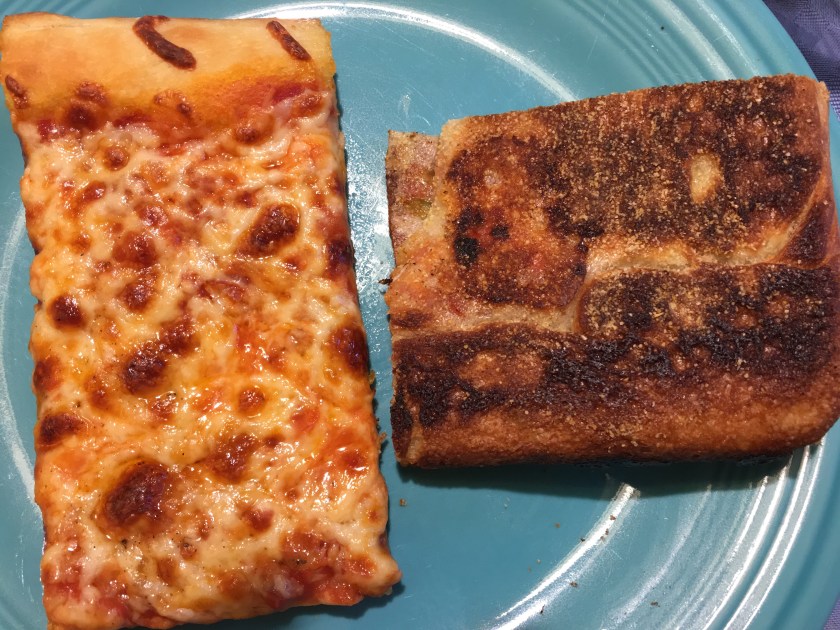
Here’s the recipe, which is Noni’s with the expanded details I needed from The Joy of Cooking. It takes a while to make from start to finish, but most of the time is not hands-on. Since it makes enough for two pizzas, I put one ball of dough aside in the fridge to use another day, which would make this process even faster (assuming it turns out well–more on that once I’ve tried it).
And the big question: does it taste like Noni’s pizza? Yes and no. The dough reminds me of hers, but the taste isn’t quite the same. With such simple ingredients, I have to imagine that one cook’s idiosyncrasies could be tough to identify or replicate. I know, for example, that Noni cooked with generous amounts of black pepper until she quit smoking around age 70, and her tastebuds recovered. I may play around with different types of tomato sauce or different amounts of pepper, but this feels like it might be as close as I get to making Noni’s pizza.

 mangia all the cussing time